Thursday, June 10, 2010

swallowed

Google
puts it all together for me

The all-intrusive medium

has a new feature this morning

Now I can select the background

opening image for my internet connexion

as illustrated above;

and now I can slip even further

into their web

and be subsumed?


Tuesday, June 8, 2010

Never judge a person by their color


A blonde city girl named Amy marries a Colorado rancher. One morning, on his way out to check on the cows, the rancher says to Amy, 'The insemination man is coming over to impregnate one of our cows today, so I drove a nail into the 2 by 4 just above where the cow's stall is in the barn. Please show him where the cow is when he gets here, OK?'


The rancher leaves for the fields. After a while, the artificial insemination man arrives and knocks on the front door. Amy takes him down to the barn. They walk along the row of cows and when Amy sees the nail, she tells him, 'This is the one right here.'


The man, assuming he is dealing with an air head blond, asks, 'Tell me lady, 'cause I'm dying to know; how would YOU know that this is the right cow to be bred?'


'That's simple," she said. "By the nail that's over its stall,' she explains very confidently.


Laughing rudely at her, the man says, 'And what, pray tell, is the nail for?'


The blonde turns to walk away and says sweetly over her shoulder, 'I guess it's to hang your pants on.'

Attention children:


History for dollars
by David Brooks
New York Times 6-7-10
When the going gets tough, the tough take accounting. When the job market worsens, many students figure they can’t indulge in an English or a history major. They have to study something that will lead directly to a job.


So it is almost inevitable that over the next few years, as labor markets struggle, the humanities will continue their long slide. There already has been a nearly 50 percent drop in the portion of liberal arts majors over the past generation, and that trend is bound to accelerate. Once the stars of university life, humanities now play bit roles when prospective students take their college tours. The labs are more glamorous than the libraries.
But allow me to pause for a moment and throw another sandbag on the levy of those trying to resist this tide. Let me stand up for the history, English and art classes, even in the face of today’s economic realities.
Studying the humanities improves your ability to read and write. No matter what you do in life, you will have a huge advantage if you can read a paragraph and discern its meaning (a rarer talent than you might suppose). You will have enormous power if you are the person in the office who can write a clear and concise memo.
Studying the humanities will give you a familiarity with the language of emotion. In an information economy, many people have the ability to produce a technical innovation: a new MP3 player. Very few people have the ability to create a great brand: the iPod. Branding involves the location and arousal of affection, and you can’t do it unless you are conversant in the language of romance.
Studying the humanities will give you a wealth of analogies. People think by comparison — Iraq is either like Vietnam or Bosnia; your boss is like Narcissus or Solon. People who have a wealth of analogies in their minds can think more precisely than those with few analogies. If you go through college without reading Thucydides, Herodotus and Gibbon, you’ll have been cheated out of a great repertoire of comparisons.
Finally, and most importantly, studying the humanities helps you befriend The Big Shaggy.
Let me try to explain. Over the past century or so, people have built various systems to help them understand human behavior: economics, political science, game theory and evolutionary psychology. These systems are useful in many circumstances. But none completely explain behavior because deep down people have passions and drives that don’t lend themselves to systemic modeling. They have yearnings and fears that reside in an inner beast you could call The Big Shaggy.
You can see The Big Shaggy at work when a governor of South Carolina suddenly chucks it all for a love voyage south of the equator, or when a smart, philosophical congressman from Indiana risks everything for an in-office affair.
You can see The Big Shaggy at work when self-destructive overconfidence overtakes oil engineers in the gulf, when go-go enthusiasm intoxicates investment bankers or when bone-chilling distrust grips politics.
Those are the destructive sides of The Big Shaggy. But this tender beast is also responsible for the mysterious but fierce determination that drives Kobe Bryant, the graceful bemusement the Detroit Tigers pitcher Armando Galarraga showed when his perfect game slipped away, the selfless courage soldiers in Afghanistan show when they risk death for buddies or a family they may never see again.
The observant person goes through life asking: Where did that come from? Why did he or she act that way? The answers are hard to come by because the behavior emanates from somewhere deep inside The Big Shaggy.
Technical knowledge stops at the outer edge. If you spend your life riding the links of the Internet, you probably won’t get too far into The Big Shaggy either, because the fast, effortless prose of blogging (and journalism) lacks the heft to get you deep below.
But over the centuries, there have been rare and strange people who possessed the skill of taking the upheavals of thought that emanate from The Big Shaggy and representing them in the form of story, music, myth, painting, liturgy, architecture, sculpture, landscape and speech. These men and women developed languages that help us understand these yearnings and also educate and mold them. They left rich veins of emotional knowledge that are the subjects of the humanities.
It’s probably dangerous to enter exclusively into this realm and risk being caught in a cloister, removed from the market and its accountability. But doesn’t it make sense to spend some time in the company of these languages — learning to feel different emotions, rehearsing different passions, experiencing different sacred rituals and learning to see in different ways?
Few of us are hewers of wood. We navigate social environments. If you’re dumb about The Big Shaggy, you’ll probably get eaten by it.

Sunday, June 6, 2010


Goldfinch
perches in downtown tree
revels in sunrise

Saturday, June 5, 2010

Wherever the just exchange their messages

This picture was hung on the basement stairwell for years. The children have sprung up and down those stairs for most of their years. The theme of course is communication.

That is what we look forward to as they sally forth into their respective worlds. The Raccoon News will be delighted when we get ensuing installments on Lee's new blog, 'Dixie in Dixie', http://leezor.blogspot.com/ and other communiques as they are able.

WH Auden:

Defenseless under the night

Our world in stupor lies;

Yet, dotted everywhere,

Ironic points of light

Flash out wherever the Just

Exchange their messages:

May I, composed like them

Of Eros and of dust,

Beleaguered by the same

Negation and despair,

Show an affirming flame.
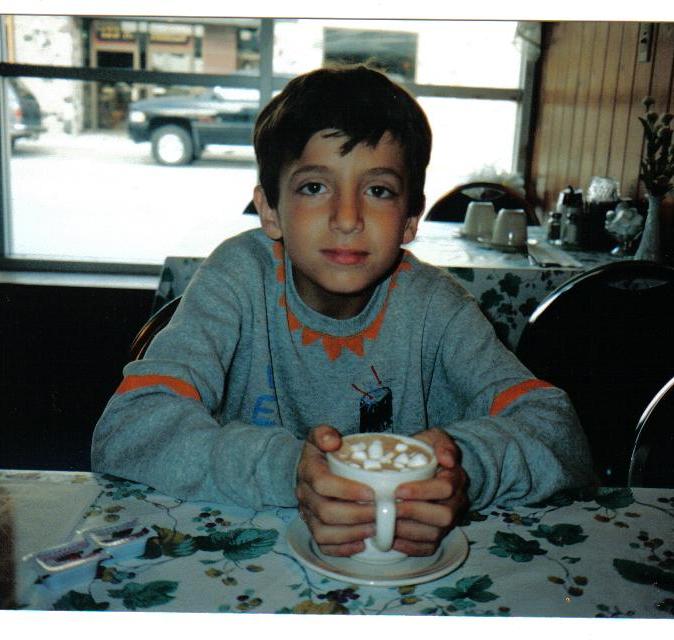
Precious Cargo / Leland ropes his way

As Lee heads out
to his first post-UW Madison job
as an elementary teacher
with Teach For America
in Houston
we are reminded of his stick-to-it-ive-ness
and beauty
through the years.

Making his mark


WHS Marching band

Age 2 with his namesake, Uncle Lee


Courage in defeat


Sharing his percussion with his fellow church members


Waves while roping his way


Friday, June 4, 2010

Norman Pripps: MEMORIES OF SPRINGSTEAD

We received the other day
a gift from our old friend and UW Madison college-mate, David James of Tucson AZ., formerly of Fox Point (Milw). We'd mentioned a subject recently that interested him in the SRN about morel mushrooms and the wooden tray we still have, made by Norman Pripps and decorated by his wife Joan Beringer Pripps.

The Pripps lived for years in Springstead WI and eventually operated a renowned little cottage industry called Studio in the Woods. Norman, a woodworker, grew up in the northern Wisconsin lumber trade. We made the Pripps' acquaintance in the 1950s when David took us to his parents' cabin on Stone Lake near Springstead. We bought some Pripps wares then, now collectors items.

Pictured above, Norman Pripps, 89 in 1999.

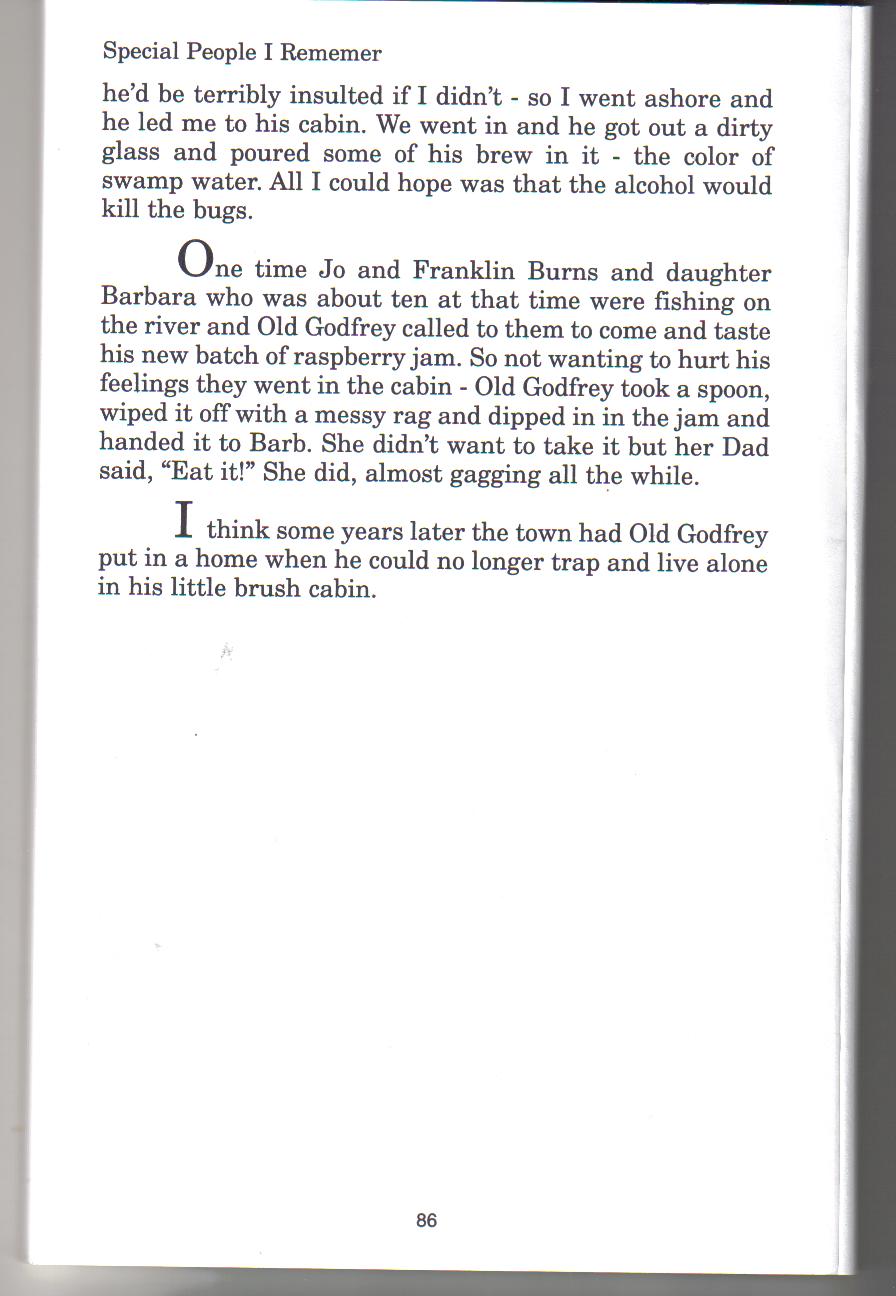
This little book, written in 1999 is about Norman's early days in Springstead at the turn of the 20th century. It was published by MacGregor Litho, Park Falls, WI. It may be out of print. David sent me this copy from a few that had purchased at its issue, so it is especially appreciated and treasured.

This is an example to my recently graduated children from the University of WI Madison, about to sail out into the next chapters of their lives, of a lasting friendship that was forged inexorably at their alma mater, UW Madison University, many years ago.

We've included one chapter of Pripps' book: OLD GODFREY.


Normie Pripps, lower right


Last chapter in the book: